Platform Overview

An operating model for enterprise AI.
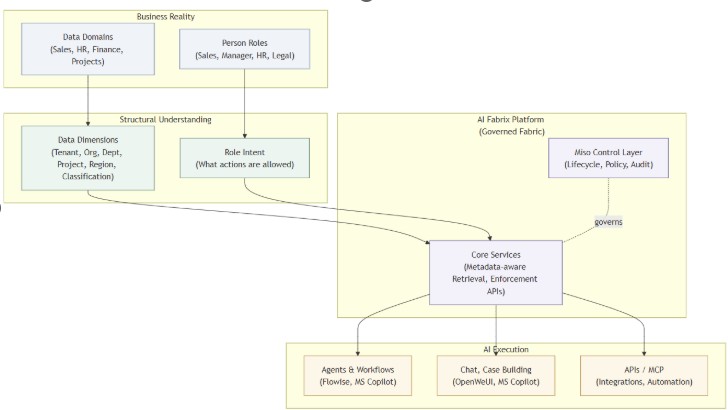
AI Fabrix is built on a small set of structural pillars designed for governance, scale, and trust.
CIP — The Dataplane Enterprise AI Needs

Most enterprise AI fails not because of models, but because AI lacks governed, contextual, per-user data. AI Fabrix solves this with CIP (Composable Integration Pipelines): an AI-native dataplane that delivers secure, permission-aware data to AI by design.

What CIP is

CIP is a declarative integration layer built for AI.

It replaces:

  • Custom integration code
  • Service accounts
  • Application-level permission logicRate limits, retries, circuit breakers enforced per environment

With:

  • In-tenant execution
  • Automatic RBAC / ABAC enforcement
  • Metadata normalization and lineage
Open contracts via OpenAPI + MCP

Think of CIP as dbt for APIs — with enterprise security and AI context built in.

Why CIP Exists

Traditional integration patterns break when AI is introduced:

  • Service accounts erase user identity
  • Permissions are duplicated and drift
  • Filtering logic leaks dataCaching via Redis; vectorization into PostgreSQL/pgvector when required.
  • Audits require reconstruction

CIP removes these failure modes structurally. AI never sees raw systems.
AI only receives governed, scoped, auditable data.

What CIP Enables

With CIP, enterprises can:

  • Give AI access to real enterprise systems — safely
  • Enforce per-user visibility automatically
  • Remove security logic from application codeFiltering logic leaks dataCaching via Redis; vectorization into PostgreSQL/pgvector when required.
  • Audit every AI interaction deterministically
  • Scale AI without scaling risk
    CIP is not iPaaS. It is not workflow automation. It is the dataplane that enterprise AI requires.
      Pillar 1: Data Understanding, Not Permissions

      Traditional platforms ask:
      “Who is allowed to access this system?”

      AI Fabrix asks:
      “What does this data represent, and who does it belong to?”

      What this means
      • Data is modeled using business dimensions, not system rules
      • Access emerges naturally from data structure
      • If data does not belong to you, it does not exist for you
      Why it matters
      • Eliminates fragile allow/deny logic
      • Removes security rules from application code
      • Makes AI-safe access the default, not an exception
        This is the foundation everything else builds on.
        Pillar 2: Structural Governance by Design

        Governance is enforced because of how the platform is built —not because someone remembered to configure it.

        AI Fabrix embeds governance into:
        • Data ingestion
        • Retrieval
        • APIs
        • AI Agents
        • User interfaces
        What this means
        • One governance model across all data sources
        • No duplicated logic across apps and integrations
        • No “special cases” for AI
          Why it matters
          • Governance scales automatically as AI usage grows
          • Audit answers are deterministic, not forensic
          • Compliance is explainable, not negotiated

            This is how AI becomes deployable in regulated environments.

        Pillar 3: In-Tenant by Default

        AI Fabrix runs where your data already lives.

        There is no shared SaaS layer.
        No external control plane.
        No black box.

        What this means
        • Deployed entirely inside the customer’s Azure tenant
        • Customer controls identity, network, keys, and data
        • AI Fabrix adapts to enterprise environments — not the other way around
        Why it matters
        • No data gravity issues
        • No compliance boundary crossings
        • No vendor lock-in by architecture

          This is a prerequisite for enterprise trust.

        Pillar 4: Separation of Business, Platform, and Code

        AI Fabrix enforces a clear contract between humans and systems.

        Business defines
        • Data dimensions
        • Person roles
        • Organizational structure
            Platform enforces
            • Data visibility
            • Policy consistency
            • Auditability
                • Developers implement
                  • Integrations
                  • Workflows
                  • AI behavior
                      Why it matters
                      • Business intent is no longer lost in code
                      • Developers stop re-implementing governance
                      • Changes are structural, not procedural

                        AI Fabrix enforces a clear contract between humans and systems.

                        Pillar 5: AI as a First-Class Enterprise Citizen

                        AI is not an add-on.
                        It is treated as a native actor in the platform.

                        AI Fabrix assumes:
                        • AI will access many systems
                        • AI will act on behalf of users
                        • AI will amplify both correctness and mistakes
                        What this means
                        • AI sees only pre-filtered, governed data
                        • The same rules apply to humans, APIs, and agents
                        • No “AI exception paths” exist
                            Why it matters
                            • AI can be trusted with real enterprise data
                            • Risk does not scale with intelligence
                            • Adoption accelerates instead of stalling
                                Pillar 6: Open Foundation, Controlled Execution

                                Openness without control creates risk. Control without openness creates lock-in.

                                AI Fabrix deliberately separates the two.

                                What this means
                                • Built on open-source foundations
                                • Portable containers and standard Azure services
                                • Controlled execution through a governed platform layer
                                Why it matters
                                • Customers can exit without losing their architecture
                                • Enterprises avoid long-term platform risk
                                • Innovation is enabled without losing control

                                    Most platforms manage access.
                                    AI Fabrix enables understanding.
                                    That is the difference between controlling AI and being able to use it.

                                          Webflow V32 Clean Baseline 5 hrs ago Submit comment